
I managed just over one book per month in 2017 by just reading 30 minutes per day. I should have written a proper review for each one but I didn’t. So in an effort to catch up, here are all 16 books I read in 2017 with a review about the size of a tweet.
Superintelligence: Paths, Dangers, Strategies (Nick Bostrom)
Eventually the difference in intelligence between a human and a computer will be equivalent to the the difference in intelligence between a beetle and human. Who do you think is going to be in charge in that world?
Zero Zero Zero (Roberto Saviano)
Everyone you know is taking cocaine. Maybe not everyone but don’t go betting your life savings on which ones aren’t. You’re going to lose it and the winner will probably spend it on cocaine.
Prisoners of Geography: Ten Maps That Tell You Everything You Need To Know About Global Politics (Tim Marshall)
Have you heard all that talk about China surpassing the USA? It’s not going to happen. America has the trump card (and it’s not the guy in office). Their geographical advantage is simply too great.
A Short History of Nearly Everything (Bill Bryson)
In the short time that humans have been around, many great people have lived and they’ve made many great discoveries. Their conclusion? The universe is old, the universe is huge, the universe loves emptiness, the universe hates life.
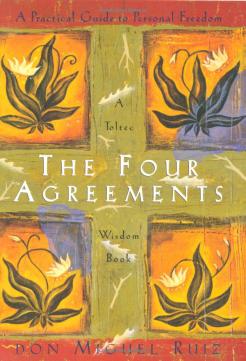
The Four Agreements: A Practical Guide to Personal Freedom (A Toltec Wisdom Book) (Don Miguel Ruiz, Janet Mills)
We’re often prisoners/slaves to our assumptions which are almost always the result of indoctrination not critical thinking. In effect, we’re living our lives based on an agreement handed down to us. We’d probably be happier if we made an agreement with ourselves.
Lateral Thinking: A Textbook of Creativity (Edward de Bono)
Sometimes expertise is the biggest blocker to progress. The obvious narrows our field of vision and blocks out the improbable but possible. The way to innovate is to be prepared abandon established paradigms.
Peopleware: Productive Projects and Teams (Tom DeMarco, Tim Lister)
Too often we focus on the efficient at the expense of the effective. The former is for processes, the latter is for people. Building software is about people and relationships. Most developers don’t recognize this and neither do most non-developers.
Metaphors We Live By (George Lakoff, Mark Johnson)
Our choice of words and sentence construction might be influencing our actions a lot more than we realize or would like to admit. Also, this sentence:
It includes some of the central insights of the phenomenological tradition, such as the rejection of epistemological foundationalism.
Think And Grow Rich (Napoleon Hill)
What happens when you ask 500 of the most successful people in the world how they got rich? They tell you that they first thought about how rich they want to be and then did it. And when you read a book 50 years after it was written you get to laugh at the stupid shit people used to believe.
Change Directions: Perceive it, Believe it, Achieve it (Georges Philips)
If things aren’t going the way you want, you’re unlikely to hope your way to change. You need a concrete goal, a concrete plan and determined execution if change is to happen. (I’m surprised that I paid money for a book to tell me this).
Playing to Win: How Strategy Really Works (A. G. Lafley, Roger Martin)
Strategy is about focus, which means strategy is about tradeoffs, which means strategy is about being about choosing what not to do. If your business ‘strategy’ doesn’t rule out any category of customer then make sure your white flag is readily accessible.
The Dip: The extraordinary benefits of knowing when to quit (and when to stick) (Seth Godin)
Second place is really the first of the losers. If you’re not aiming for first you might as well aim for last. If you’re aiming for last then it makes sense to quit now.
Of Mice and Men (John Steinbeck)
Sometimes you have to shoot your best friend in the back of the head. That doesn’t necessarily make you a bad person. (You’ll probably still end up in prison though).
Eat That Frog!: Get More of the Important Things Done – Today! (Brian Tracy)
Only a few things guaranteed in life. One of those guarantees is that if the very first thing you do tomorrow after waking up is eat a frog (cooked or raw, up to you) your day is only going to go uphill from there.
Leaders Eat Last: Why Some Teams Pull Together and Others Don’t (Simon Sinek)
Organisations are composed of people. People have feelings and feelings can be hurt. There is simply no organisation that gets better results from hurting their people’s feelings than they do from making their people happy. Great leaders know this.
The 7 Habits of Highly Effective People: Powerful Lessons in Personal Change (Stephen R. Covey)
What do highly effective people have in common? Daily private victories (3), daily public victories (3) and a spirit of continuous improvement (1). 3 + 3 + 1 = 7.
Wrapping it all up
There you have it. 16 books. Looking at this list two things really stand out:
- One non-fiction
- Complete lack of diversity of authors
Both will be addressed in 2018.
 In 30 Minutes