Executive Presence (book review)

How did I hear about it?

Executive Presence: The Missing Link Between Merit and Success

Now I’ve completed it and …?

What are some sample quotes?

Becoming a leader and doing something amazing with your life hinge on what makes you different, not on what makes you the same as everyone else

Gravitas is the very essence of EP. Without it, you simply won’t be perceived as a leader, no matter what your title or level of authority

Great leaders are brutally optimistic

Your communication skills, both verbal and nonverbal, are what ultimately win you the attention and mindshare of colleagues, clients, and friends

It may be more important to comfort a room than command it

Sensitivity can spell the difference between sounding like a leader and actually succeeding as one

To radiate presence you have to radiate that you are present

Was it worth the money?

0062246895-01-s001-lxxxxxxx

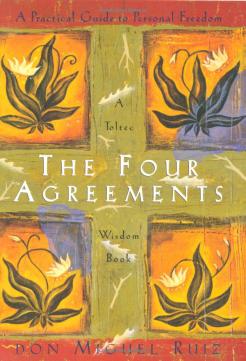
The Four Agreements (book review)

How did I hear about it?

I don’t know how The Four Agreements ended up on my reading list. I don’t mean that I don’t remember the sequence of steps I took to add it, I mean it seems impossible that such a book would be on my reading list. You see the full title of this book is The Four Agreements: Practical Guide to Personal Freedom (Toltec Wisdom Book) and it’s the Toltec Wisdom bit of the title that normally acts as a repellent. Toltec is an ancient Mesoamerican culture and if there’s one thing we know about wisdom from ancient cultures its that they’re notorious for being wrong. Yes, it’s true. Still the book was on my list so I assume I had a well researched reason for adding it. I started reading and the drill is simple, if I start reading a book then I have to complete it.

Now I’ve completed it and …?

I really enjoyed this book. I read it in one afternoon. It’s not very big but also Don Miguel Ruiz makes his points using simple, natural language without patronising the reader. The key point is that we live our lives based on agreements we’ve made with society. Unfortunately society’s primary goal is control and we didn’t have much of a say in the agreements as they have been drilled into us since we were children.

One such agreement, for example, is when as a child you’re singing and your parents tell you that you don’t sing well. After hearing this repeatedly you eventually stop singing because you have come to the agreement that you don’t have a good singing voice. It doesn’t matter that singing makes you happy, you would rather deny yourself that pleasure than break the agreement. Of course you can’t blame your parents because they too had the same agreements imposed on them.

According to “Toltec” wisdom (more on that later) all that matters is happiness and you only need four agreements with yourself to find happiness. These are 1) be impeccable with your word, 2) don’t make assumptions, 3) don’t take things personally and 4) always do your best. That’s it. Break the old agreements, adopt these new ones*, live happily ever after.

As for all this talk about Toltec wisdom it’s like calling your ice cream flavour Planifolia, it might attract hippies but ultimately it’s still just Vanilla.

* ignore the fact that this is someone else telling you to make these agreements

What are some sample quotes?

We train our children whom we love so much the same way that we train any domesticated animal: with a system of punishment and reward

Death is not the biggest fear we have; our biggest fear is taking the risk to be alive

The word is the most powerful tool you have as a human

Your opinion is nothing but your point of view. It is not necessarily true

Nothing other people do is because of you. It is because of themselves

Do not expect people to tell you the truth because they also lie to themselves

When we believe something, we assume we are right about it to the point that we will destroy relationships in order to defend our position

Was it worth the money?

As I stated earlier, I had reservations about reading this book but once I did read it I thought it was well worth the (admittedly quite small) effort. The four agreements speak for themselves and are pretty obvious but the surrounding narrative really helps to reinforce the point.

Verdict: Buy.

The four agreements (cover photo)

Give and Take (book review)

How did I hear about it?

Give and Take is one of those books that seem to have always been, inexplicably, near the top of my reading list. I knew I really wanted to read it but had no idea why. I had never heard of the author, no one I know has ever admitted to reading it and the title clearly didn’t get reviewed by a marketing agency (or at the very least i hope they had a generous refund policy).

More than likely I read some other book and at the end my kindle said “People who read this also liked… Give and Take” and being nothing but a hairless ape I went along with the shrewdness. Yes folks, a group of apes is called a shrewdness, just one of the many facts you’ll learn here. I digress.

Now I’ve completed it and …?

Give and Take follows the age old tradition of social science books by making a bold assertion then following up with copious amounts of evidence in the form of research and anecdotes. Adam Grant does this particularly well by sharing stories that start out as doom and gloom case studies in naïvety but inevitably ends with everyone living happily ever after. He does it throughout the book in varying forms and on each occasion I’m left surprised at the outcome.

In a nutshell the book suggests that there are three types of people. Takers see others as exploitable and use them as stepping stones to satisfy their own goals. Givers help others out of a sense of duty to society and therefore look for nothing in return. Matchers treat others in the way they’re treated and so give to receive and take to compensate. It’s pretty obvious that most people are Matchers. As for the Givers and Takers you can pretty much guess which one of those most often find themselves at the bottom of the pile. And if you guessed Takers then according to Grant you guessed wrong.

Takers seem to only do well in short term and/or zero sum situations. Once they’re found out, news spreads quickly and everyone becomes guarded when dealing with them. Who would have guessed, most people don’t like being exploited and don’t like seeing others being exploited. If you’re a Giver you have the opposite effect, all the matchers as well as other givers start routing for you. Interestingly, the act of giving/helping others actually increases the size of the pie, so the more people give the more opportunities there are for all of us. Why aren’t we all giving?

What are some sample quotes?

You can’t just ignore someone because you don’t think they’re important enough

The fear of being judged as weak or naïve prevents many people from operating like givers at work

If we create networks with the sole intention of getting something, we won’t succeed

We should see networks as a vehicle for creating value for everyone, not just claiming it for ourselves

You should be willing to do something that will take you five minutes or less for anybody

Even in seemingly independent jobs that rely on raw brainpower, our success depends more on others than we realize

Givers get extra credit when they offer ideas that challenge the status quo

Was it worth the money?

I’m going to be honest, I really like this book. I really, really like it. I first read it a few months ago then basically re-read it to write this review, which I don’t normally do. The problem is that the message is so potent and so appealing and so basic that a simple blog post would have sufficed. In fact I could say it in just 4 words: Don’t be a dick!

Verdict: Hold.

Give and take (cover photo)

To Sell is Human (book review)

Why did I read this book?

I once read a book called Drive by a guy called Dan Pink who did a TED Talk called The puzzle of motivation that was a real eye opener. So profound an impact the book had that I decided I had to read more material from the author. He’s written about 5 books in total but the title of one in particular really caught my attention: To Sell is Human.

I’ve never been any good at selling things, including myself, and here was a book suggesting that one of my weaknesses should come as naturally as walking or talking. It made sense to give this one a go (especially considering that the other books had slightly less inspiring titles like Free Agent Nation and something, something Johnny Bunko).

Now I’ve completed it and …?

To sell is human cemented my view of Dan Pink as an author. Here he effortlessly combines a wealth of social science research, expert opinion and personal experience to raise my awareness in an area that is totally necessary but to which I was mostly blind and/or incompetent.

Pink starts by describing the traditional sales man, a guy with hair full of gel, a face full of confidence and a mouth full of lies. In today’s world where information on any product is near ubiquitous and consumer feedback is public such a person is part of a dying breed. Consumers are becoming more and more savvy so the only way to keep them coming back is to add real value over and above that which they can already create for themselves. Today it is the seller that needs to be weary or the buyer. There is a need for a more modern type of selling.

Now, this is great advice for a salesperson currently missing targets but this hardly seems relevant to me. Actually Pink makes a very compelling argument that we are all salespeople. The job of sales is about convincing others to exchange a resource they have for something else of (hopefully) equivalent value. For a traditional salesperson that’s exchanging money for a product like a blender or lawnmower or whatever. If you’re a teacher that exchange would be time and attention for knowledge. If you’re a personal trainer that exchange could be effort and dedication for a healthy body. In general, if you’re trying to influence others or as Pink puts it “move others” then your objective is no different from the salesperson and  neither should your skills.

As humans we’re social creatures whose survival and progress as a species depends heavily on interacting with other humans. Combined with the sentiment above there is only one conclusion, to sell is human. The title practically wrote itself.

What are some sample quotes?

One smart, easy, and effective way to get inside people’s heads is to climb into their chairs

We’re more likely to be persuaded by those whom we like

Negativity and negative emotions are crucial for our survival

The potential to be good at something can be preferred over actually being good at that very same thing

For many of us, the opposite of talking isn’t listening. It’s waiting

The most effective tools for excavating people’s buried drives are questions

Contrast operates within, and often amplifies, every aspect of persuasion

Was it worth the money?

I found this book very useful in helping me identify the practices I had which were driving my “customers” away. On top of that it provided me with a new set of tools that I could use to more effectively deliver my message. I picked this up with the hope of learning to pitch to investors but put it down better equipped in my role as a mentor*. Trust me, anything that makes motivating 10 year olds easier is a great investment so at £6.45 this was a steal.

Verdict: Buy.

To sell is human - cover photo  61mnrynuidl

* Reach Out – Mentoring that works.

The Coaching Habit (book review)

Why did I read this book?

I have a friend who I’ve known since high school and who I’ve always admired for his inner drive and relentless pursuit of his goals. He’s now vice chancellor of a university, author of a few books, hosts a talk show and has presented to many illustrious audiences including at the UN. One day he told me that he recently got a coach and it was the best career decision he has ever made. I went and got a coach.

After working with my coach I started to realize that my management focus had primarily been on improving performance, not developing performers. It wasn’t enough to coach, I too needed to start coaching. After a bit of research and asking around I was eventually led to The Coaching Habit.

Now I’ve completed it and …?

Michael Bungay Stanier starts by highlighting research that shows that the coaching style of leadership is proven to be one of the most effective at improving workplace performance and organisational culture. It has a demonstrably positive effect on the bottom line and yet it is one of the least used styles.

There are primarily two reasons for this. On the one hand, most people have no idea of the benefits of coaching and/or how to go about doing so. On the other hand, we’re programmed from a very early age to provide answers. Most of the rewards in society comes from providing the right answers, whether it be in school, work, games or our social circles. Our default position is to instruct, tell our staff what to do, instead of giving them the tools to formulate their own solutions. This is what coaching is about.

Given the dual nature of the problem, The coaching habit provides a dual track solution. One track focuses on how to form habits. This includes the essential components of forming effective habits as well as tools that can help in the process. The outcome of this track is a “new habit formula” to be used whenever faced with the default behaviour of giving answers.

The second track, which focuses on effective coaching, is distilled into 7 questions. 7 amazing questions. 7 beautiful questions. That’s it, 7 questions that will unlock the potential of your staff and finally transform you into an effective manager. Combined with the new habit formula anyone, in any situation, at any experience level can start applying the ‘technique’ which will ultimately evolve into a way of thinking. It’s too easy.

What are the questions?

I want to stay away from the specifics of the books I review as this blog is about the meaning I took away and I want the readers to try (or not) the book for themselves to find their own meaning. I’ll make an exception in this case. Here are the 7 questions.

What’s on your mind?

And what else?

What’s the real challenge here for you?

What do you want?

How can I help?

If you’re saying yes to this, what are you saying no to?

What was most useful for you?

And finally, not one of the questions but my new favourite phrase…

The answer to how is yes

Was it worth the money?

Remember that time when people thought the earth was flat* and stationery? I mean, it was obvious, we stand upright, our buildings – apart from that one in Pisa – stand upright, no one was suffering from dizziness. Of course the earth is flat! Then one day some guy rocks up and proves that not only was the earth not flat, it was ‘spherical’ and rotating. Imagine how those people must have felt. Well I don’t have to imagine because that’s how I felt after reading this. I would have easily paid 10 times the amount for this book having read it. Do you know what you else you could get for that kind of money? It doesn’t matter!

Verdict: Go buy this book now. Buy a few, for your boss, for your staff, for random strangers on the street.

The coaching habit cover photo The answer to how is yes cover photo

*There are a few who still do